

Breakthrough in shellfish farming: you need to read this
You’ve got to sit down to
read this. You won’t regret it.
A message from Ralf, our founder
Mussel App was created four years ago with one big goal: to improve shellfish farming using real farm data.
Our biggest challenge was always data collection and data quality. But the goal never changed. I didn’t want Mussel App to simply store information. I wanted it to eventually look at what is happening on your farm and give you genuine, useful input about how you could farm better.
This year, with the growth of AI, a lot of our model training has accelerated.
But this week we had a breakthrough that genuinely made a few of us almost fall off our chairs.
A little boring background
(Feel free to skip this bit if you just want the exciting part.)
Originally, we used fairly simple mathematics to predict future growth.
If your shellfish grew 2 mm every month, we could reasonably predict they would be roughly 2 mm bigger the following month.
Simple.
As Mussel App grew and we collected more data, we moved to machine-learning models, including Support Vector Machines (SVMs). That allowed us to account for something every farmer already knows: growth isn’t linear.
Oysters, mussels and seaweed don’t grow at exactly the same rate throughout their entire lifecycle.
About a year ago, as the cost of processing dropped dramatically (our internal joke is that all the old crypto-mining machines got turned into AI machines 😉), we moved further into heuristic forecasting and started combining farm data with environmental and weather information.
And that’s where things started getting really interesting.
What happened this week
We continuously feed our internal models with structured information provided by farmers, combined with environmental and weather data.
The system keeps predicting.
If you already use our prediction features, you’ll know the results can be incredibly accurate on one farm and still be off on another. That’s because the system is still learning, and every farm is different.
We keep improving the models, changing what data we give them and testing how they respond.
But yesterday we tried something different.
We took three customer accounts with at least 12 months of structured Mussel App data, together with their connected environmental information.
Our internal model isn’t like ChatGPT or Claude. It doesn’t really “talk”. It produces statistical information.
So we took the output from our forecasting models, passed it through a probabilistic decision model, and then connected that output to an LLM so it could interpret and explain what the models were seeing.
Then we waited.
Are you sitting down?
The system started asking us questions.
Not generic AI questions.
It looked at the actual farm records and effectively said:
If you want me to help you farm better, I need you to record X more consistently on Farm A, and Y on Farm B.
And it explained why.
It identified where the existing data was already strong enough to detect patterns, where information was missing, and exactly what additional measurements would allow it to make better predictions.
These are examples of the real feedback generated from actual farm data:
Case one
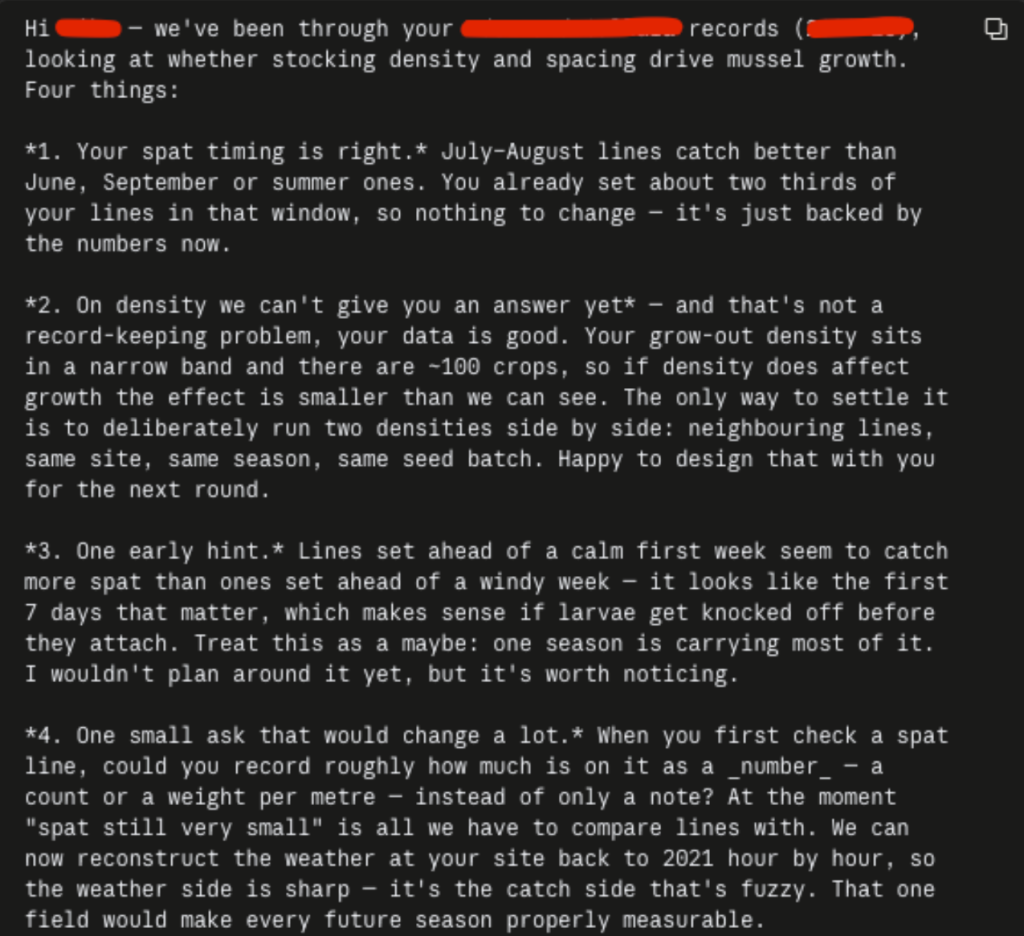
Case two
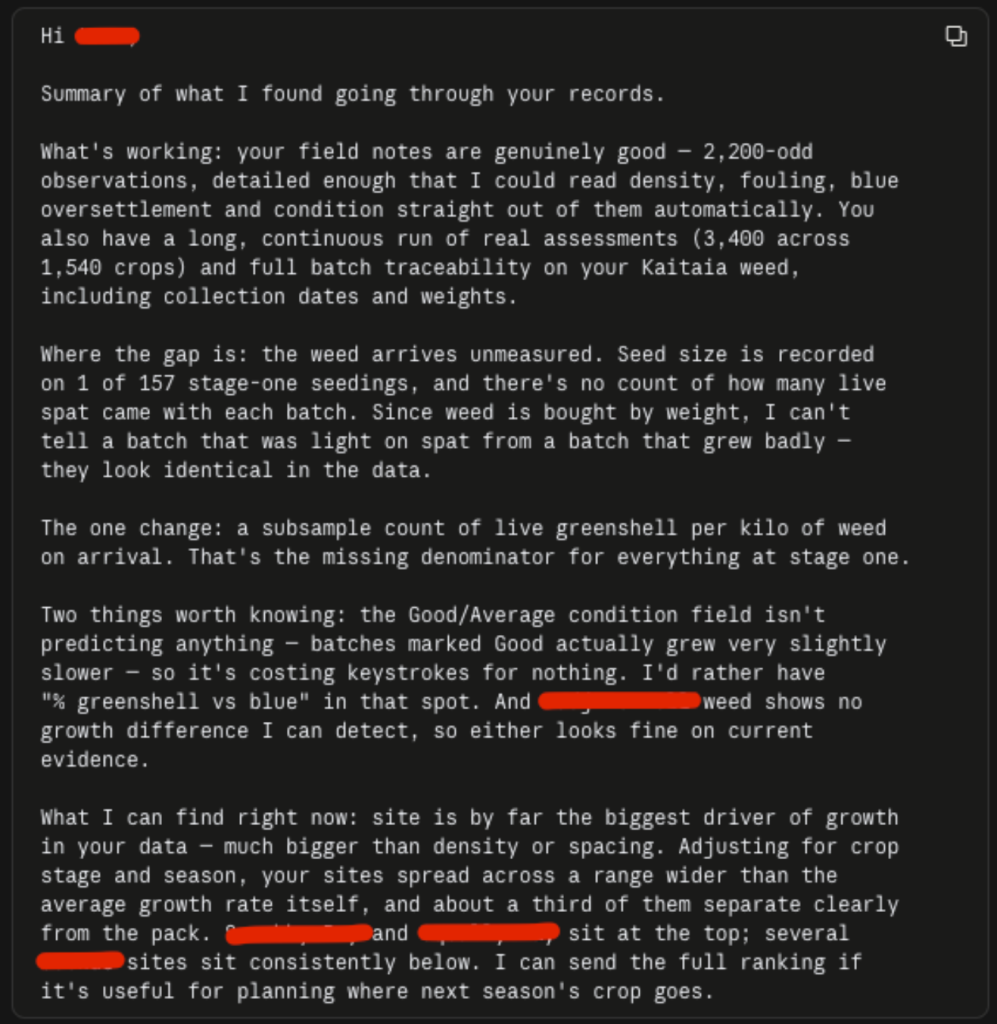
Case three

That is the breakthrough.
It’s no longer only:
“Here is what happened on your farm.”
We’re moving towards:
“Here is what the data suggests is happening, and here is the information I need from you to understand it better and help you grow more.”
What happens next?
There’s something slightly scary and incredibly exciting about watching these models improve and finding relationships we didn’t explicitly program them to look for.
But there is a reason this works.
Your data is structured in a way that almost nobody else in this industry has.
Seedings, movements, assessments, density, harvests, environmental information and years of farm history can all be connected.
That’s what makes this possible.
Over the next month, we’ll start releasing insights like these to existing Mussel App customers.
And the more structured information we collect together, the more useful these models become.
Four years ago, I genuinely thought we’d reach this point around 2030. It was actually in some of my original presentations.
We’re here four years early.
I’m incredibly proud of our team, and equally grateful to the farmers who have stuck with us, entered the data, challenged us, corrected us and helped us build this.
We are finally getting to the point where I believe this technology can make a genuine impact on how shellfish farms operate.
If you’d like to talk about what this could mean for your farm, flick me an email.
I’m very happy to walk you through it and explain how, somehow, four different types of AI and machine-learning models are now working together to get us here. 🙂
Feeling very proud and very happy,
-Ralf
Founder, Mussel App

